BEGIN:VCALENDAR
VERSION:2.0
PRODID:-//jEvents 2.0 for Joomla//EN
CALSCALE:GREGORIAN
METHOD:PUBLISH
BEGIN:VTIMEZONE
TZID:Europe/Paris
BEGIN:STANDARD
DTSTART:20241104T123000
RDATE:20250330T030000
TZOFFSETFROM:+0200
TZOFFSETTO:+0100
TZNAME:Europe/Paris CET
END:STANDARD
BEGIN:STANDARD
DTSTART:20251026T020000
RDATE:20260329T030000
TZOFFSETFROM:+0200
TZOFFSETTO:+0100
TZNAME:Europe/Paris CET
END:STANDARD
BEGIN:STANDARD
DTSTART:20261025T020000
RDATE:20270328T030000
TZOFFSETFROM:+0200
TZOFFSETTO:+0100
TZNAME:Europe/Paris CET
END:STANDARD
BEGIN:STANDARD
DTSTART:20271031T020000
RDATE:20280326T030000
TZOFFSETFROM:+0200
TZOFFSETTO:+0100
TZNAME:Europe/Paris CET
END:STANDARD
BEGIN:DAYLIGHT
DTSTART:20250330T030000
RDATE:20251026T020000
TZOFFSETFROM:+0100
TZOFFSETTO:+0200
TZNAME:Europe/Paris CEST
END:DAYLIGHT
BEGIN:DAYLIGHT
DTSTART:20260329T030000
RDATE:20261025T020000
TZOFFSETFROM:+0100
TZOFFSETTO:+0200
TZNAME:Europe/Paris CEST
END:DAYLIGHT
BEGIN:DAYLIGHT
DTSTART:20270328T030000
RDATE:20271031T020000
TZOFFSETFROM:+0100
TZOFFSETTO:+0200
TZNAME:Europe/Paris CEST
END:DAYLIGHT
END:VTIMEZONE
BEGIN:VEVENT
UID:273bc4219ddab19503fd803dad0c3320
CATEGORIES:L'échangeur
CREATED:20251009T102659
SUMMARY:Reframing the Neolithic, Trévor Watkins, professeur émérite à l’Université d’Édimbourg
LOCATION:MSH Mondes (bât. Ginouvès)\, salle 1 (rez-de-jardin) - 21 allée de l'univer
sité\, Nanterre\, \, 92000\,
DESCRIPTION:Avec Trévor Watkins, professeur émérite à l’Université d’Édimbourg.\nIf we
are to advance our understanding of prehistory we need to fit our archaeolo
gical knowledge into an understandingof the (cultural) evolutionary process
. That was what I was attempting with my recent book, Becoming Neolithic, w
hose synthesis was framed in the context of cultural niche construction the
ory. Writing prehistory is very different from the writing of history. As 2
025 is the centenary of Gordon Childe’s first major publication, and of the
Abercromby Chair of Archaeology at the University of Edinburgh, to which h
e was appointed, it is appropriate to start by discussing how he reframed t
he writing of prehistory, and how popular and influential were his books an
d ideas (in particular, the Neolithic and urban revolutions. In the 1960s A
merican archaeologist-anthropologists Lewis Binford and Kent Flannery and t
heir colleagues (under the banner of “processualist” archaeology) attempted
to update the writing of prehistory within the contemporary framework of e
volution and eco-systems theory. Since then, evolutionary theory has been f
urther transformed (the extended evolutionary synthesis) including the deve
lopment of new fields, like (cultural) niche construction theory. At the sa
me time systems theory has grown with new theoretical work on complexity an
d complex adaptive systems theory. These theoretical advances are challengi
ng archaeologists, both researchers, and teachers, and students. \n
X-ALT-DESC;FMTTYPE=text/html: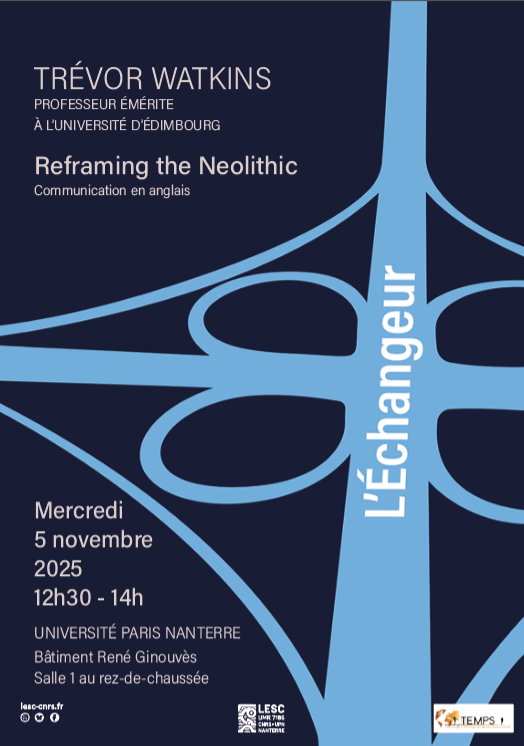 Avec Trévor Watkins, professeur émérite à l’Univer
sité d’Édimbourg.
Avec Trévor Watkins, professeur émérite à l’Univer
sité d’Édimbourg.
If we are to advance our understanding of prehistor
y we need to fit our archaeological knowledge into an understandingof the (
cultural) evolutionary process. That was what I was attempting with my rece
nt book, Becoming Neolithic, whose synthesis was framed in th
e context of cultural niche construction theory. Writing prehistory is very
different from the writing of history. As 2025 is the centenary of Gordon
Childe’s first major publication, and of the Abercromby Chair of Archaeolog
y at the University of Edinburgh, to which he was appointed, it is appropri
ate to start by discussing how he reframed the writing of prehistory, and h
ow popular and influential were his books and ideas (in particular, the Neo
lithic and urban revolutions. In the 1960s American archaeologist-anthropol
ogists Lewis Binford and Kent Flannery and their colleagues (under the bann
er of “processualist” archaeology) attempted to update the writing of prehi
story within the contemporary framework of evolution and eco-systems theory
. Since then, evolutionary theory has been further transformed (the extende
d evolutionary synthesis) including the development of new fields, like (cu
ltural) niche construction theory. At the same time systems theory has grow
n with new theoretical work on complexity and complex adaptive systems theo
ry. These theoretical advances are challenging archaeologists, both researc
hers, and teachers, and students.
DTSTAMP:20261016T211736
DTSTART;TZID=Europe/Paris:20251105T123000
DTEND;TZID=Europe/Paris:20251105T140000
SEQUENCE:0
TRANSP:OPAQUE
END:VEVENT
END:VCALENDAR