BEGIN:VCALENDAR
VERSION:2.0
PRODID:-//jEvents 2.0 for Joomla//EN
CALSCALE:GREGORIAN
METHOD:PUBLISH
BEGIN:VTIMEZONE
TZID:Europe/Paris
BEGIN:STANDARD
DTSTART:20211031T020000
RDATE:20220327T030000
TZOFFSETFROM:+0200
TZOFFSETTO:+0100
TZNAME:Europe/Paris CET
END:STANDARD
BEGIN:STANDARD
DTSTART:20221030T020000
RDATE:20230326T030000
TZOFFSETFROM:+0200
TZOFFSETTO:+0100
TZNAME:Europe/Paris CET
END:STANDARD
BEGIN:STANDARD
DTSTART:20231029T020000
RDATE:20240331T030000
TZOFFSETFROM:+0200
TZOFFSETTO:+0100
TZNAME:Europe/Paris CET
END:STANDARD
BEGIN:STANDARD
DTSTART:20241027T020000
RDATE:20250330T030000
TZOFFSETFROM:+0200
TZOFFSETTO:+0100
TZNAME:Europe/Paris CET
END:STANDARD
BEGIN:STANDARD
DTSTART:20251026T020000
RDATE:20260329T030000
TZOFFSETFROM:+0200
TZOFFSETTO:+0100
TZNAME:Europe/Paris CET
END:STANDARD
BEGIN:STANDARD
DTSTART:20261025T020000
RDATE:20270328T030000
TZOFFSETFROM:+0200
TZOFFSETTO:+0100
TZNAME:Europe/Paris CET
END:STANDARD
BEGIN:STANDARD
DTSTART:20271031T020000
RDATE:20280326T030000
TZOFFSETFROM:+0200
TZOFFSETTO:+0100
TZNAME:Europe/Paris CET
END:STANDARD
BEGIN:DAYLIGHT
DTSTART:20210523T100000
RDATE:20211031T020000
TZOFFSETFROM:+0100
TZOFFSETTO:+0200
TZNAME:Europe/Paris CEST
END:DAYLIGHT
BEGIN:DAYLIGHT
DTSTART:20220327T030000
RDATE:20221030T020000
TZOFFSETFROM:+0100
TZOFFSETTO:+0200
TZNAME:Europe/Paris CEST
END:DAYLIGHT
BEGIN:DAYLIGHT
DTSTART:20230326T030000
RDATE:20231029T020000
TZOFFSETFROM:+0100
TZOFFSETTO:+0200
TZNAME:Europe/Paris CEST
END:DAYLIGHT
BEGIN:DAYLIGHT
DTSTART:20240331T030000
RDATE:20241027T020000
TZOFFSETFROM:+0100
TZOFFSETTO:+0200
TZNAME:Europe/Paris CEST
END:DAYLIGHT
BEGIN:DAYLIGHT
DTSTART:20250330T030000
RDATE:20251026T020000
TZOFFSETFROM:+0100
TZOFFSETTO:+0200
TZNAME:Europe/Paris CEST
END:DAYLIGHT
BEGIN:DAYLIGHT
DTSTART:20260329T030000
RDATE:20261025T020000
TZOFFSETFROM:+0100
TZOFFSETTO:+0200
TZNAME:Europe/Paris CEST
END:DAYLIGHT
BEGIN:DAYLIGHT
DTSTART:20270328T030000
RDATE:20271031T020000
TZOFFSETFROM:+0100
TZOFFSETTO:+0200
TZNAME:Europe/Paris CEST
END:DAYLIGHT
END:VTIMEZONE
BEGIN:VEVENT
UID:ebc7b6048e866ebdf021c1b125db31a9
CATEGORIES:Journées d’étude
CREATED:20220518T090231
SUMMARY:Reenacting Landscapes
LOCATION:Université Paris Nanterre - 200 avenue de la République\, Nanterre\, \, 920
23\,
DESCRIPTION: In the bodiless non-places of accelerated capitalis
t life, in the anxiety of the Covid present, in the toxic sites of the so-c
alled Anthropocene, what does it mean today to get a taste for landscape? W
hy should one care, and how might the refined ‘palate’, implicit in conserv
ative notion of taste, be reconfigured differently, opened up to democracy
and dissensus? We approach these generic questions via a specific route: na
mely, by interrogating the performative potential – the theatricality, no l
ess – of reenactment, a mode of artistic intervention that since Rebecca Sc
hneider’s pioneering study Performing Remains: Art and War in Times of Thea
trical Reenactment (2011) has been a common trope within theatre and perfor
mance studies as well as art history and visual culture in general. But per
haps now – for the reasons intimated above – it is time to rethink and reap
ply the idea of reenactment, to come terms, somewhat ironically, with its a
fterlives and possibilities.
In the bodiless non-places of accelerated capitalis
t life, in the anxiety of the Covid present, in the toxic sites of the so-c
alled Anthropocene, what does it mean today to get a taste for landscape? W
hy should one care, and how might the refined ‘palate’, implicit in conserv
ative notion of taste, be reconfigured differently, opened up to democracy
and dissensus? We approach these generic questions via a specific route: na
mely, by interrogating the performative potential – the theatricality, no l
ess – of reenactment, a mode of artistic intervention that since Rebecca Sc
hneider’s pioneering study Performing Remains: Art and War in Times of Thea
trical Reenactment (2011) has been a common trope within theatre and perfor
mance studies as well as art history and visual culture in general. But per
haps now – for the reasons intimated above – it is time to rethink and reap
ply the idea of reenactment, to come terms, somewhat ironically, with its a
fterlives and possibilities.
In this study day we look to interrogate
the relationship between reenactment and landscape precisely because the v
ery idea of landscape was always already bound up with repetition and re-do
ing: the attempt, that is, by landscape gardeners in the eighteenth century
to transpose images from paintings into the very material of the landscape
itself; to create aestheticised, tasteful ways of seeing and being. In thi
s study day, landscape is no longer conceived as a primarily visual practic
e or disposition; rather, it is approached as verb, both active and passive
, something that one does as a body, as a skin, a choreography, a performan
ce, a type of theatre. Equally, taste is not a set of rules or protocols th
at one can apply or discover, as if in some manual; it is a sensate experie
nce, an open-ended, always corporeal event, something that fills the percei
ver with enthusiasm and affect. To get a taste for landscape, in other word
s, is to get a taste for life, which, in keeping with the uncanny, troublin
g logic of reenactment is also to pay attention to ghosts, spectres and pha
ntoms, to make kin with the living dead – all those that refuse to depart t
he stage (mise-en-scène).
This study day will be of interest to acade
mic and practice-based researchers in art, theatre, performance, ethnograph
y, geography, archaeology, history, politics, philosophy and literature.
Journée on and off-line organisée dans le cadre du projet RePiT (Labex
Les Passés dans le Présent) par Baptiste Buob (Lesc), Nathalie Cau (HAR), C
arl Lavery (Glasgow University, Ecology, Environment and Heritage Hub) et C
hristophe Triau (HAR).
[Salle L205, bâtiment Ricœur, Nanterre / Lien
de l'appel vidéo : https://meet.google.com/adz-crgx-ibn]
Progr
amme
9h30 Accueil café
10h00
; Carl Lavery : « Reenacting Landscapes »
10h30
Lee Hassall : « Reenactment : Transmatic Reanimation »
11h15 Clare Finburgh-Delijani : « Spectral Sea
scapes : performer les fantômes postcoloniaux en France »
1
1h45 Alexandre Koutchevsky : « Théâtre-paysage »
, dialogue avec Christophe Triau
12h30 – 13h30 : pause déjeuner<
/p>
13h30 – 15h : Workshop mené par Simon Whitehead
15h15
; Sophie Sleigh-Johnson : « Disorientation: Reach for
the Ground »
15h45 Emmanuel de Vienne : «
Peindre et perdre la culture : l’œuvre d’Amatiwana Trumai »
16h30 Annette Becker : « Les paysages du Rwanda et l
es reenactments des traumas du génocide des Tutsis »
17h00
Nathalie Cau : « “Dérober au néant noms et figures” :
paysages de mémoire, essai filmé (tentative in progress) »
X-ALT-DESC;FMTTYPE=text/html: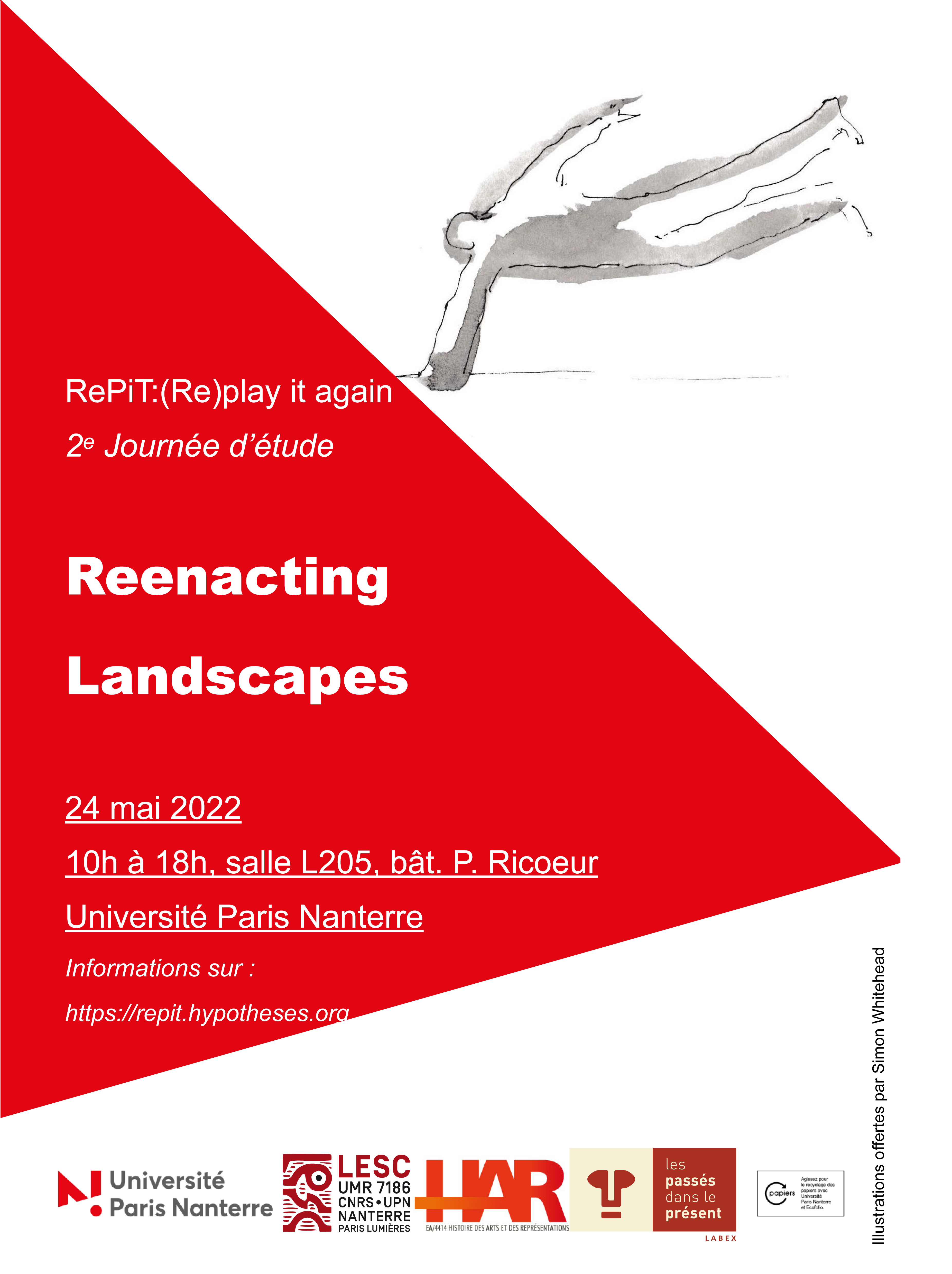 In the bodiless non-places
of accelerated capitalist life, in the anxiety of the Covid present, in th
e toxic sites of the so-called Anthropocene, what does it mean today to get
a taste for landscape? Why should one care, and how might the refined ‘pal
ate’, implicit in conservative notion of taste, be reconfigured differently
, opened up to democracy and dissensus? We approach these generic questions
via a specific route: namely, by interrogating the performative potential
– the theatricality, no less – of reenactment, a mode of artistic intervent
ion that since Rebecca Schneider’s pioneering study Performing Remains: Art
and War in Times of Theatrical Reenactment (2011) has been a common trope
within theatre and performance studies as well as art history and visual cu
lture in general. But perhaps now – for the reasons intimated above – it is
time to rethink and reapply the idea of reenactment, to come terms, somewh
at ironically, with its afterlives and possibilities.
In the bodiless non-places
of accelerated capitalist life, in the anxiety of the Covid present, in th
e toxic sites of the so-called Anthropocene, what does it mean today to get
a taste for landscape? Why should one care, and how might the refined ‘pal
ate’, implicit in conservative notion of taste, be reconfigured differently
, opened up to democracy and dissensus? We approach these generic questions
via a specific route: namely, by interrogating the performative potential
– the theatricality, no less – of reenactment, a mode of artistic intervent
ion that since Rebecca Schneider’s pioneering study Performing Remains: Art
and War in Times of Theatrical Reenactment (2011) has been a common trope
within theatre and performance studies as well as art history and visual cu
lture in general. But perhaps now – for the reasons intimated above – it is
time to rethink and reapply the idea of reenactment, to come terms, somewh
at ironically, with its afterlives and possibilities.
In this study d
ay we look to interrogate the relationship between reenactment and landscap
e precisely because the very idea of landscape was always already bound up
with repetition and re-doing: the attempt, that is, by landscape gardeners
in the eighteenth century to transpose images from paintings into the very
material of the landscape itself; to create aestheticised, tasteful ways of
seeing and being. In this study day, landscape is no longer conceived as a
primarily visual practice or disposition; rather, it is approached as verb
, both active and passive, something that one does as a body, as a skin, a
choreography, a performance, a type of theatre. Equally, taste is not a set
of rules or protocols that one can apply or discover, as if in some manual
; it is a sensate experience, an open-ended, always corporeal event, someth
ing that fills the perceiver with enthusiasm and affect. To get a taste for
landscape, in other words, is to get a taste for life, which, in keeping w
ith the uncanny, troubling logic of reenactment is also to pay attention to
ghosts, spectres and phantoms, to make kin with the living dead – all thos
e that refuse to depart the stage (mise-en-scène).
This study day wil
l be of interest to academic and practice-based researchers in art, theatre
, performance, ethnography, geography, archaeology, history, politics, phil
osophy and literature.
Journée on and off-line organisée dans le cadr
e du projet RePiT (Labex Les Passés dans le Présent) par Baptiste Buob (Les
c), Nathalie Cau (HAR), Carl Lavery (Glasgow University, Ecology, Environme
nt and Heritage Hub) et Christophe Triau (HAR).
[Salle L205, bâtiment
Ricœur, Nanterre / Lien de l'appel vidéo : https://meet.google.com/adz-
crgx-ibn]
Programme
9h30 Accueil ca
fé
10h00 Carl Lavery : « Reenacting Landscapes
»
10h30 Lee Hassall : « Reenactment : Tran
smatic Reanimation »
11h15 Clare Finburgh-Delijani :
« Spectral Seascapes : performer les fantômes postcoloniaux
en France »
11h45 Alexandre Koutchevsky : «&nb
sp;Théâtre-paysage », dialogue avec Christophe Triau
12h30 – 13h
30 : pause déjeuner
13h30 – 15h : Workshop mené par Simon W
hitehead
15h15 Sophie Sleigh-Johnson : « D
isorientation: Reach for the Ground »
15h45 Emmanuel
de Vienne : « Peindre et perdre la culture : l’œuvre d’Amat
iwana Trumai »
16h30 Annette Becker : « Le
s paysages du Rwanda et les reenactments des traumas du génocide des Tutsis
»
17h00 Nathalie Cau : « “Dérober au néan
t noms et figures” : paysages de mémoire, essai filmé (tentative in pr
ogress) »
DTSTAMP:20261016T212500
DTSTART;TZID=Europe/Paris:20220524T100000
DTEND;TZID=Europe/Paris:20220524T180000
SEQUENCE:0
TRANSP:OPAQUE
END:VEVENT
END:VCALENDAR